
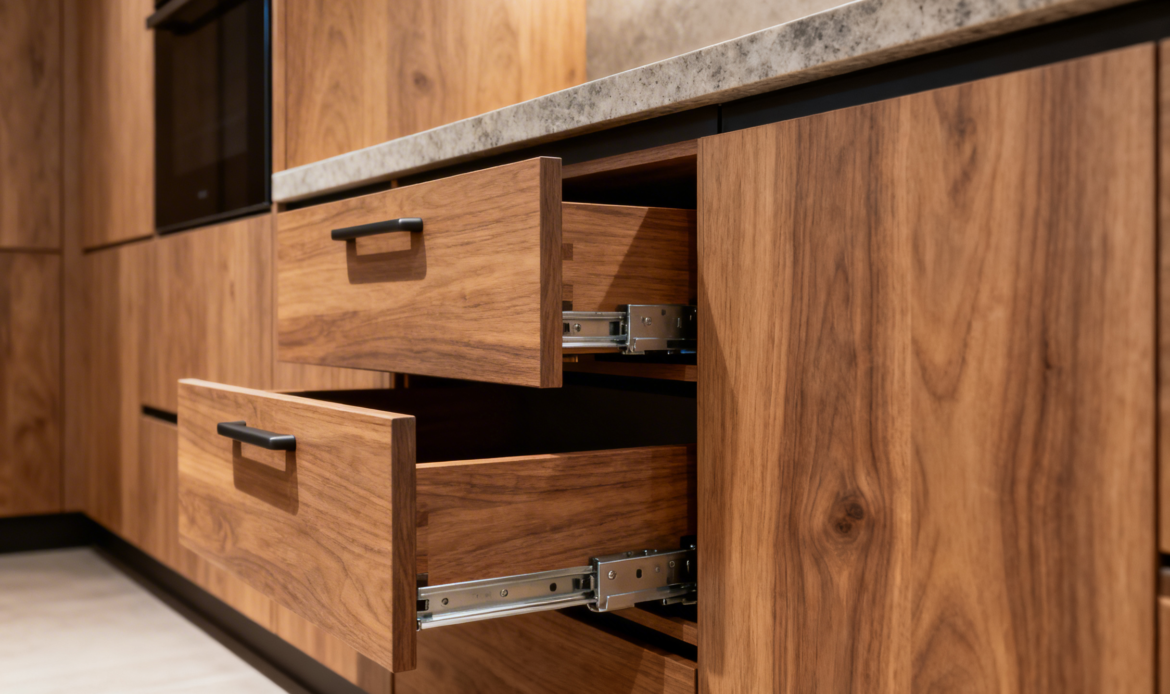
The hidden schedule killer in multifamily construction isn’t weather or permits—it’s your cabinets.
In the fast-paced world of Miami multifamily development, where every day of delay translates to thousands in carrying costs, traditional custom cabinetry has become an unexpected bottleneck. While developers focus on structural milestones and mechanical systems, cabinet installation quietly consumes weeks of critical path time, holding up unit completions and delaying revenue.
The solution isn’t cutting corners on quality. It’s rethinking the entire approach through modular cabinet systems that deliver precision-engineered luxury at unprecedented speed.
The Hidden Time Cost of Traditional Cabinetry
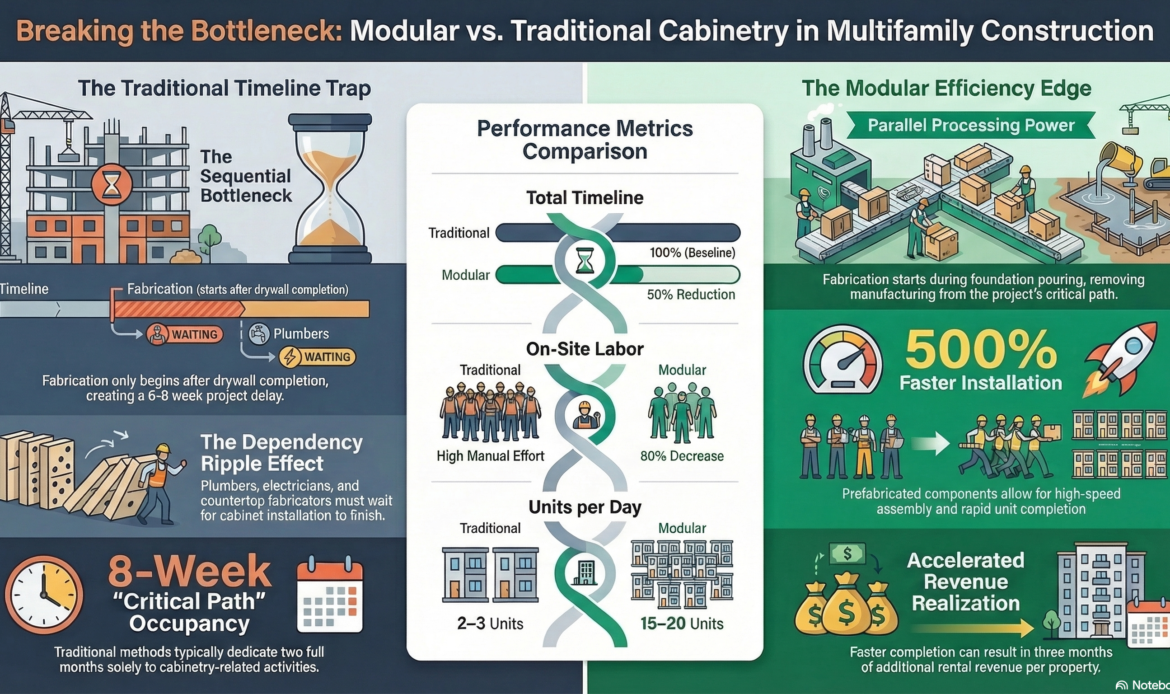
Traditional custom cabinetry in multifamily projects follows a predictable yet problematic sequence. Field measurements begin only after drywall completion, triggering a 4-6 week fabrication period. Installation then requires another 2-3 weeks of on-site assembly, adjustment, and coordination with other trades.
The compounding effect across hundreds of units creates scheduling nightmares. A 200-unit development might dedicate 8-10 weeks solely to cabinetry—time when finished units sit idle, unable to generate revenue. Factor in the inevitable measurement errors, material shortages, and coordination conflicts, and cabinet installation becomes the silent project killer that no one sees coming.
Beyond pure timeline impact, traditional methods create ripple effects throughout the construction sequence. Plumbers wait for cabinet specs before finalizing rough-ins. Electricians need confirmed dimensions for undercabinet lighting. Countertop fabricators remain on hold until base cabinets are installed and verified. Each dependency multiplies the potential for delays.
How Modular Systems Streamline Multifamily Projects
Modular cabinet systems fundamentally restructure this timeline through parallel processing and pre-engineering. Instead of sequential measurement, fabrication, and installation, modular systems enable simultaneous manufacturing while site construction progresses.
The approach begins during design development, not after drywall. Standardized modules with predetermined dimensions integrate directly into architectural drawings, allowing all trades to coordinate from fixed specifications months before installation. This early certainty eliminates the measurement phase entirely and enables off-site fabrication to begin while foundations are still being poured.
Pre-engineered components arrive on-site as complete assemblies, not raw materials requiring extensive field labor. Installation crews work from detailed placement plans, positioning fully finished modules that connect through engineered joining systems. What traditionally required skilled cabinetmakers working for weeks becomes a systematic process completed by installation teams in days.
The efficiency gains are measurable: 50% reduction in total timeline, 80% decrease in on-site labor hours, and near-elimination of punch list items related to cabinetry. For developers, this translates directly to accelerated unit delivery and faster revenue realization.
Key Components of Effective Modular Cabinet Systems
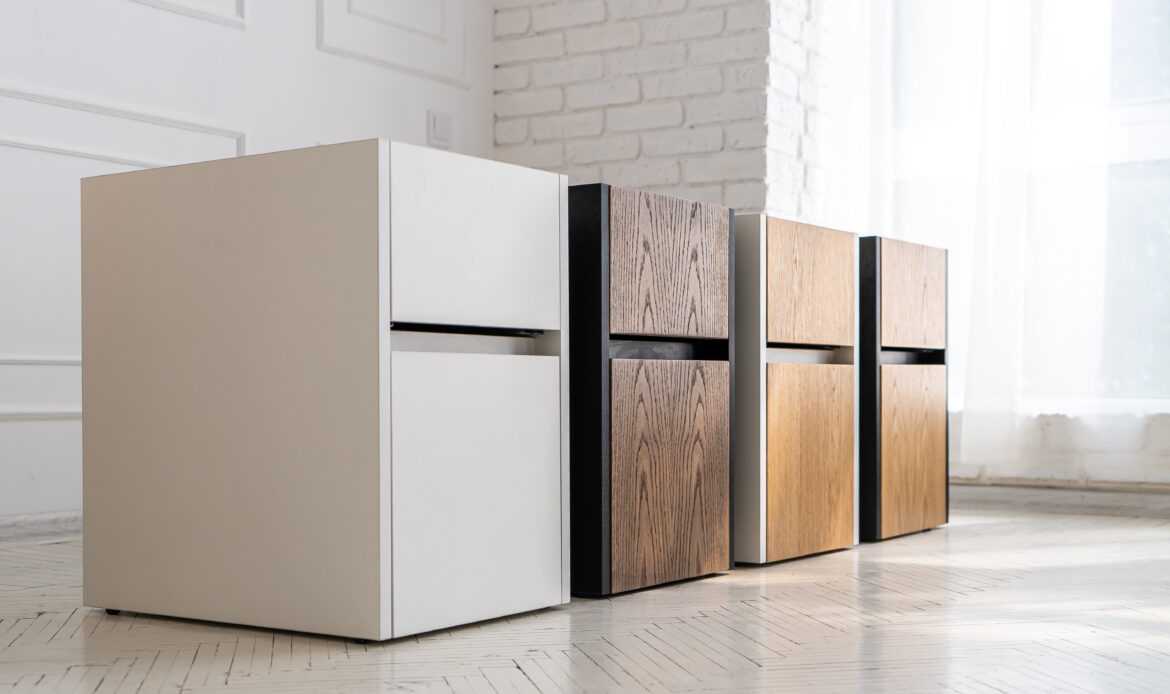
Successful modular systems balance standardization with flexibility through intelligent component design. The foundation lies in dimensional coordination—modules sized to work within standard architectural grids while accommodating typical appliance dimensions and plumbing locations.
Structural Framework
The cabinet box itself employs engineered construction methods that ensure dimensional stability during transport and installation. Marine-grade plywood boxes with doweled joints resist Miami’s humidity fluctuations, while pre-installed adjustable legs compensate for minor floor variations without requiring shims or field modifications.
Connection Systems
Proprietary joining hardware enables rapid assembly while maintaining structural integrity. Cam-lock systems allow modules to connect in minutes, creating continuous runs indistinguishable from site-built cabinetry. Integrated wire management channels and utility cutouts come pre-configured, eliminating field drilling that often damages finishes.
Finish Flexibility
While boxes remain standardized, door and drawer front systems offer extensive customization. Interchangeable panels allow last-minute finish selections without impacting production schedules. This separation of structure from aesthetics provides developers the flexibility to adjust unit finishes based on market positioning without delaying overall timelines.
Quality Control Integration
Factory production enables quality control measures impossible in field conditions. Automated cutting ensures precise dimensions. Climate-controlled assembly spaces eliminate weather-related delays. Each module undergoes inspection before shipping, arriving on-site ready for immediate installation.
Real-World Timeline Comparisons: Modular vs. Traditional
The theoretical advantages of modular systems crystallize when examining actual project timelines. Consider a recent 200-unit luxury development in Brickell where Maplehaus implemented a fully modular approach.
Traditional timeline projection showed 6 weeks for cabinet installation across all units, with dependencies creating an additional 2-week buffer for coordination issues. The critical path allocated 8 weeks total for cabinetry-related activities.
The modular implementation compressed this to 14 days of on-site work. Pre-engineering occurred during schematic design, adding zero days to the schedule. Off-site fabrication proceeded parallel to sitework and structure, effectively removing manufacturing from the critical path. Installation crews completed 15-20 units per day using four-person teams, compared to traditional crews managing 2-3 units daily.
Beyond raw speed, the modular approach eliminated common delay triggers. No waiting for field measurements. No custom modifications for out-of-square walls. No back-ordered components halting progress. The predictability alone justified the approach for the development team, who could confidently schedule subsequent trades without buffer time.
Cost implications extended beyond labor savings. Faster unit completion meant earlier certificate of occupancy, translating to three months of additional rental revenue across the property. Reduced construction loan interest alone offset any premium for modular components.
The Future of Multifamily Construction
Modular cabinet systems represent more than a scheduling solution—they signal a fundamental shift in how luxury multifamily projects approach interior finishes. As Miami’s development community faces increasing pressure to deliver units faster while maintaining quality standards, the traditional sequential construction model becomes increasingly untenable.
The data speaks clearly: properly implemented modular systems deliver measurable improvements in schedule, cost, and quality. The 200-unit Brickell project isn’t an anomaly—it’s becoming the new standard for sophisticated developers who understand that time truly is money in multifamily construction.
For those still relying on traditional custom cabinetry, the question isn’t whether to adopt modular systems, but how quickly you can integrate them into your next project. The competitive advantage lies not in craftsmanship—modern modular systems match or exceed site-built quality—but in the ability to deliver luxury units weeks ahead of conventionally-built competition.
The evolution from custom to modular doesn’t mean sacrificing the bespoke quality that defines luxury multifamily properties. It means delivering that quality through intelligent engineering and systematic execution rather than time-intensive field labor. In Miami’s competitive development landscape, that efficiency edge increasingly determines project success.
Continue the Conversation
If you are planning an interior project and want to explore how bespoke cabinet design can be integrated as part of a broader interior system, we welcome the conversation.
Our work begins early, with clarity around layout, materials, and execution.